
Supercitizens, Antanas Mockus
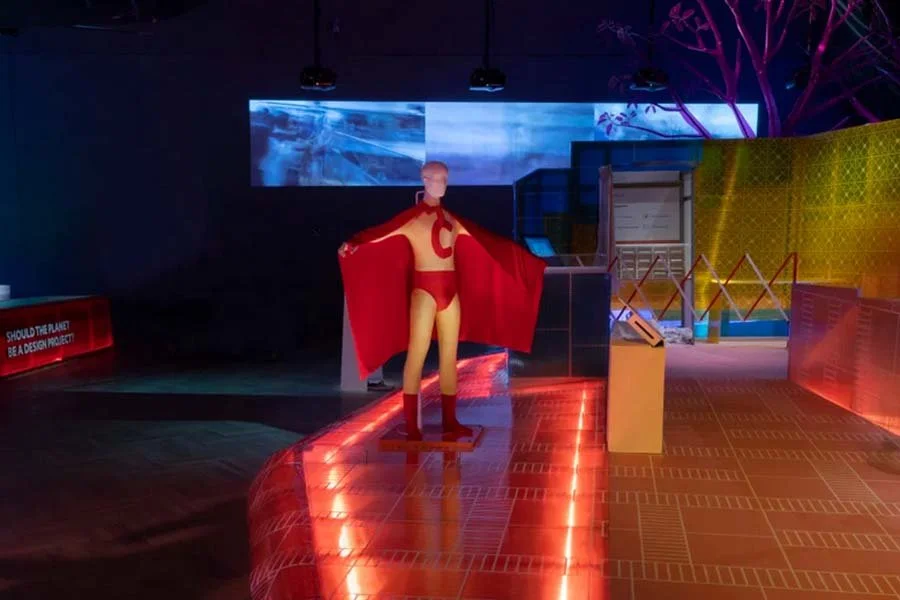
V&A Museum “The Future Starts Here” Exhibition features “Super Citizen” suit created by Bogotá’s mayor, Antanas Mockus (2018). Image courtesy of the V&A Museum.
What if the transformative potential of play can help us find new common ground in our civic life?
We have outrage fatigue. Whether flipping through cable news channels or skimming social media feeds, it doesn’t take long to witness the breakdown in our civic discourse. Particularly in the Trump era, our punditry has fed a debate-driven culture that rewards the outlandish and hyperbolic. In the process, we have seemingly lost the capacity to empathize with perspectives and opinions other than our own. We have forgotten that listening involves more than merely tuning in for what we want to hear, or waiting for someone else to finish before we speak. How can we truly foster public cultures and ways of being in real relationship with one another?
Perhaps one of the most inspiring examples comes in the unlikely form of Antanas Mockus, the professor-turned-politician who served as Bogotá’s mayor from 1995-1997 and 2001-2004. Following his dismissal as rector of the National University of Colombia in 1993 for mooning rowdy art students who had refused to let him speak, Mockus entered Bogotá’s mayoral race as an inexperienced independent and won by the largest majority in the city’s history. The only son of a Lithuanian artist, Mockus brought a distinctly creative governing approach to a city whose drug cartels, poverty, murder and corruption had earned it the inspired moniker “the worst city on the planet”. With a degree in philosophy, the unconventional mayor, who often appeared in public in a superhero-like “Supercitizen” suit, believed that the city would transform itself if he could inspire people to change their behavior.
Deeming ‘Bogotanos’ to be more fearful of ridicule than fines, Mockus replaced the notoriously corrupt traffic police with 420 trained mimes who made fun of traffic violators. Drivers were given ‘thumbs up’ and ‘thumbs down’ signs to further encourage good behavior, while pedestrians who jay-walked or blocked traffic received yellow or red cards similar to those used by soccer referees to signal fouls.
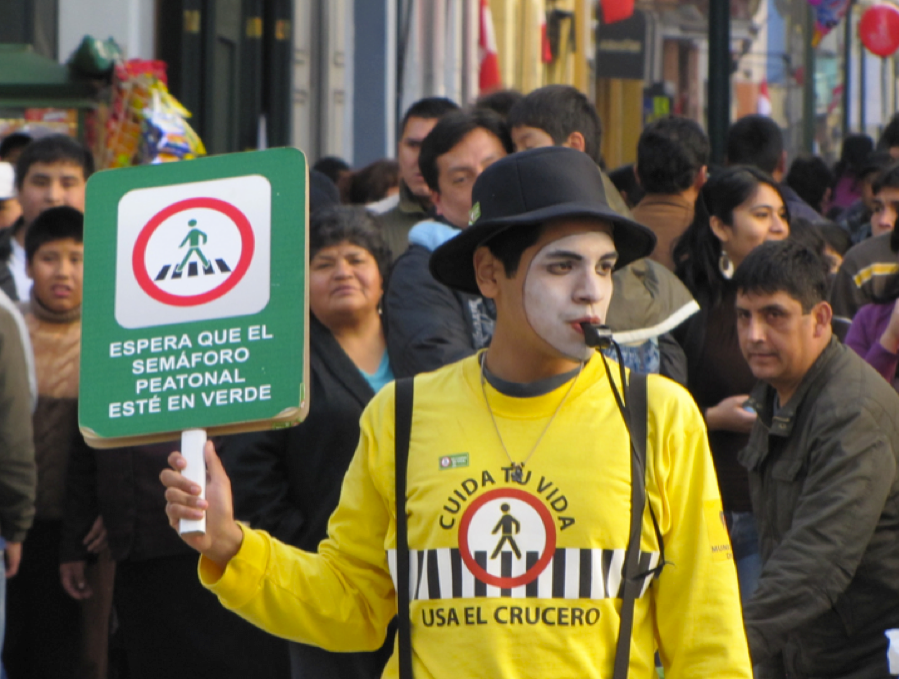
Mimes replace traffic police to reinforce good traffic etiquette in Bogotá (1995). Image courtesy of the V&A Museum.
During a water shortage, Mockus appeared on television taking a shower and turning the water off while he soaped, asking fellow citizens to follow suit. Within two months the city was using 14% less water.
Mockus also asked people to call his office if they met a kind and honest taxi driver. He then organized a meeting with all of these taxi drivers who as the newly appointed “Knights of the Zebra” advised him on how to improve the overall behavior of the others.
Stirring our Senses
Of his unconventional approach, the Supercitizen explained, “if people…are sensitized by art, humor, and creativity, they are much more likely to accept change, and each other.” By focusing on the hearts and minds of his citizens and employing unconventionally artistic strategies, Mockus created an atmosphere of optimism bolstered by the power of the individual and communal pride. His playful antics helped Colombian citizens become more open to seeing each other’s shared humanity and feel empowered to affect change. During his first term as mayor, the homicide rate decreased by 70%, traffic fatalities decreased by 50%, and 63,000 residents voluntarily chose to pay more taxes.
As a state of mind, play has the ability to foster mindfulness, responsiveness and yielding. It helps us give ourselves over to the moment, to the other, and to the relationship beyond the words we say. Contemporary projects, such as Hirsch & Mann’s Stop, Smile and Stroll and Ralph Borland’s Suited for Subversion demonstrate how play creates a better human experience by lowering our defenses and opening us to the potential for a meaningful encounter. And in that space, something revelatory can happen. We learn to experience each other differently, and find a bridge to the ‘other.’
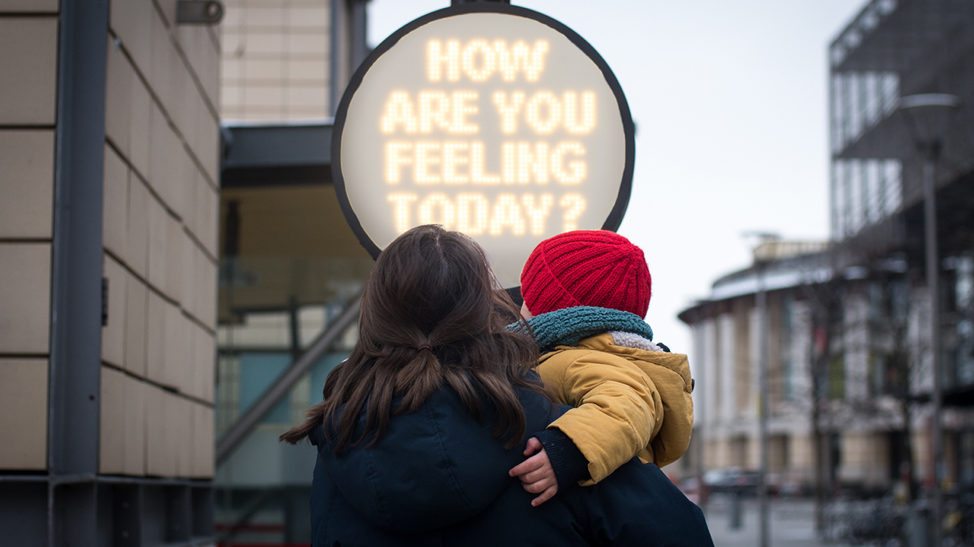
Hirsch & Mann’s Stop, Smile and Stroll (2018) – a playful intervention for pedestrian crossings that asks pedestrians to express their current mood through facial expressions that it reads to determine the city’s collective ‘mood of the moment.’ Image courtesy of Playable City.
How it Moves us, Forward
Krista Tippett, host of the award-winning radio program On Being, makes a case for why we need ‘bridge people’ today more than ever. “There is a human change that makes social change happen that is much quieter and more dispersed. It has to do with a quality of relationship between unlikely combinations of people that must be fermenting in place before the overturning of structures.” Play can act as that necessary starter culture.
Antanas Mockus
Colombian mathematician, philosopher, and politician Antanaus Mockus left his post as rector of Colombian National University in Bogotá in 1993, and later the same year ran a successful campaign for mayor in the city. He proceeded to preside over Bogotá as mayor for two terms. Under his leadership, Bogotá saw remarkable improvement across the board–water usage dropped 40%, 7000 community security groups were formed and the homicide rate fell 70%, traffic fatalities dropped by over 50%, drinking water was provided to all homes (up from 79% in 1993), and sewage was provided to 95% of homes (up from 71%).